Developer tooling · 2026
dts-tracer
Policy-based request tracing for Express, in one line of middleware.
- Role
- Design, build and publish
- When
- 2026
- Stack
- TypeScript · Node.js · Express · npm
Why it needed to exist.
Full tracing stacks are heavy for small services, and most of what they collect is never read. dts-tracer flips it: decide what is interesting, capture only that, and let the app choose where it goes.
A small npm middleware that keeps only the requests worth looking at — the slow ones and the errors — and hands them to you through an in-memory log and a callback.
Constraints
- Zero configuration to start.
- Must not slow down the requests it watches.
- Storage is the app’s decision, not the library’s.
How dts-tracer decides what to keep
The middleware times each request while your handler runs untouched. When the response finishes, a policy checks duration and status; matching traces go to an in-memory buffer and an onTrace hook.
One line of middleware wraps every Express request.
Your handler runs untouched — the tracer only starts a clock.
When the response finishes, it records duration and status.
A policy decides what is worth keeping — slow requests, client errors, server errors — so logs stay small.
Matches land in an in-memory buffer you can expose, and an onTrace hook lets you persist them anywhere.
In use
What it looks like.
- server.ts
import express from "express";
import { createTraceRequest, getTraceLogs } from "dts-tracer";

const app = express();

app.use(createTraceRequest());

app.get("/logs", (_req, res) => {
  res.json(getTraceLogs());
});

app.listen(3000);
From the READMEThe whole integration: one middleware, one endpoint to read the traces. 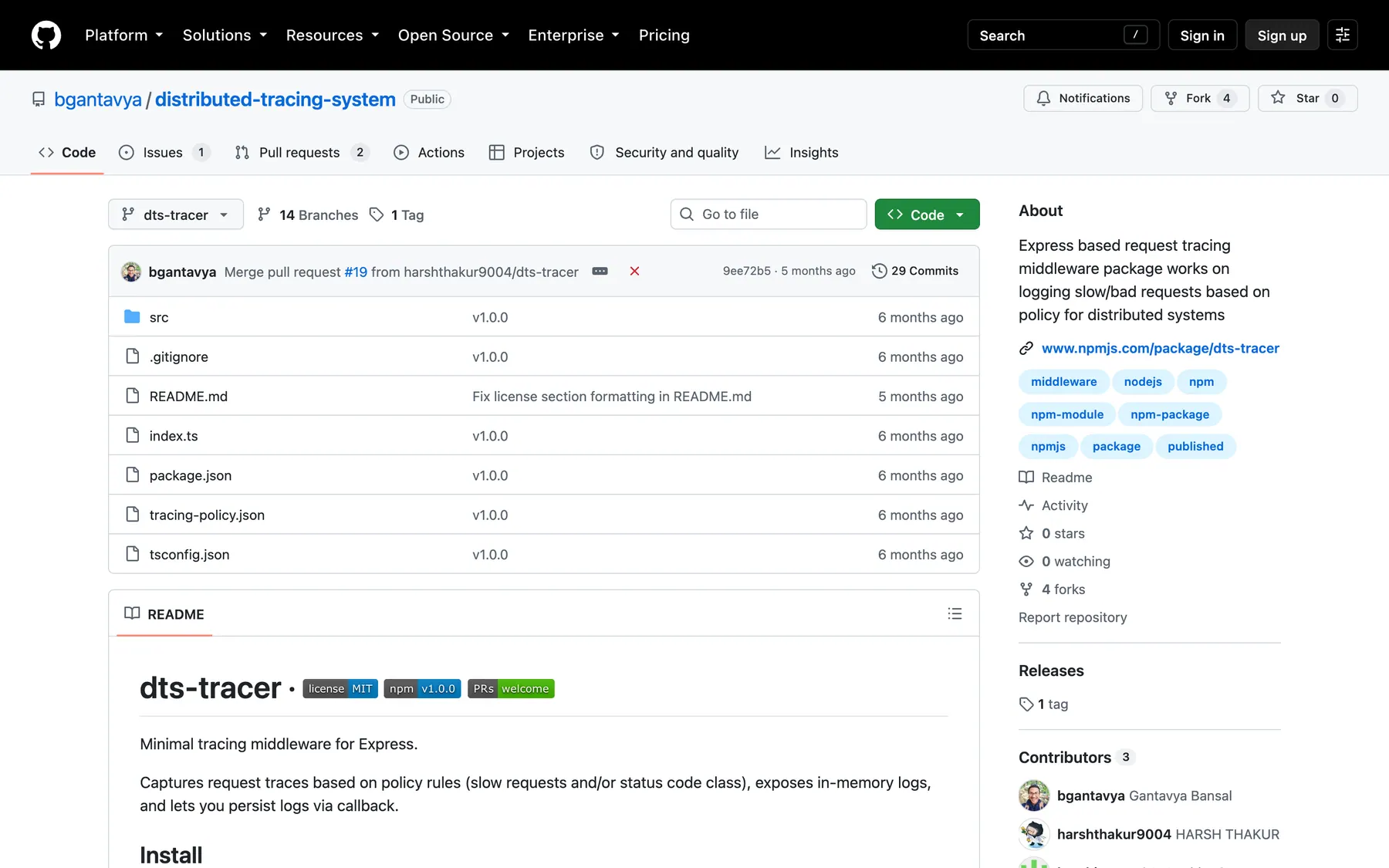
dts-tracer, in the open on GitHub. · captured Sep 2026 from github.com/bgantavya/distributed-tracing-system
Three choices, and what each one cost.
- 01
Policy over sampling
Capturing by rule (slower than N ms, 4xx, 5xx) keeps every interesting request instead of a random slice.
Trade-offA burst of errors produces a burst of traces.
- 02
In-memory by default
getTraceLogs() works out of the box for a quick /logs endpoint during development.
Trade-offBounded and reset on restart — persistence is opt-in.
- 03
A hook, not an integration
onTrace(trace) sends traces to a database, a file or an observability tool without the library depending on any of them.
Trade-offYou write three lines of glue.
What changed.
- line to adopt
- 1
- app.use(createTraceRequest())
- published on npm, fully typed
- v1.0
- open source
- MIT
The next version.
OpenTelemetry-compatible export and per-route policies.
Something like this on your plate? Write to me.