Quantitative · 2025in progress
Trade It Up
A rules-first momentum allocation engine across equity, gold and cash.
- Role
- Research and build
- When
- 2025
- Stack
- Python · NSE ETF data · Backtesting · Risk rules
- Links
- Write-upMarket note
Why it needed to exist.
Most personal investing is discretionary, and discretion is where losses hide. Trade It Up turns an allocation idea into rules a machine can follow and twenty years of history can test.
Four plain rules that shift a portfolio between NiftyBees, GoldBees and LiquidBees based on momentum — written so a backtest can check them and a person can audit them by hand.
Constraints
- Only liquid, low-cost instruments: NiftyBees, GoldBees, LiquidBees.
- Rules simple enough to audit by hand.
- Protect capital in sharp drawdowns before chasing returns.
How Trade It Up decides a mix
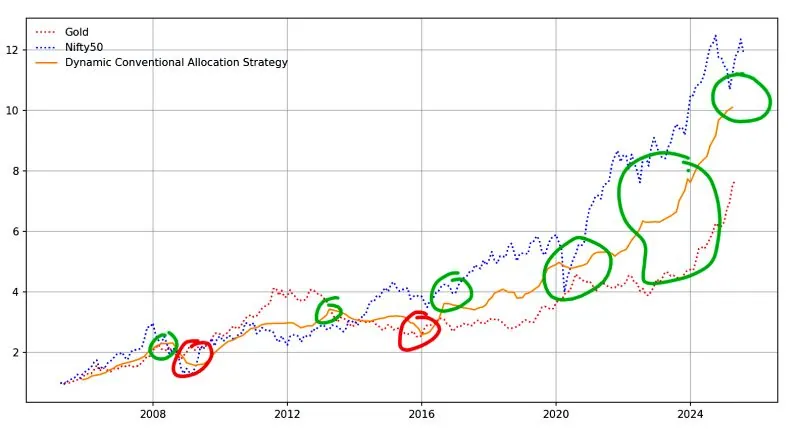
Daily ETF prices feed a simple momentum signal. Four rules map the signal to a target mix of gold, equity and cash, validated by a 20-year backtest, and the portfolio rebalances to it.
Three ETFs: NiftyBees for growth, GoldBees as the hedge, LiquidBees as cash.
The signal is simple on purpose — has either asset moved five percent or more?
Four rules map that signal to a mix. When both fall, 60% moves to cash; otherwise it leans into whichever is winning.
The rules were checked across twenty years, including 2008, 2012 and 2020, before any capital followed them.
The portfolio rebalances to the target — boring, rule-bound, no discretion.
Three choices, and what each one cost.
- 01
One visible threshold
Every rule keys off a ±5% move, so each decision can be explained in a single sentence.
Trade-offCoarse signals react later than finely tuned ones — accepted for robustness.
- 02
Cash is a first-class asset
When equity and gold fall together, 60% of the portfolio moves to a liquid fund.
Trade-offGives up some of the rebound right after a crash.
- 03
Backtest before capital
Rules are tested across two decades of market regimes before money follows them.
Trade-offBacktests flatter; only live tracking is the real test.
What changed.
- over 20 years, in backtest
- ~10×
- Read off the author’s own backtest chart (the cover), posted in August 2025; Nifty 50 ended near 12× and gold near 8× over the same years. Not a forecast.
- rules, no discretion
- 4
- instruments, all exchange-traded
- 3
The walkthrough

Watch the walkthroughGantavya explains the allocation rules and the backtest behind Trade It Up.
The next version.
Automated execution through a broker API, and live performance published alongside the backtest.
Something like this on your plate? Write to me.